Project information
- Category: Telecommunications / Cryptography
- Achievement: Winner - Smart India Hackathon 2022
- Technologies: Python, Digital Modulation, Cryptography
- Domain: Public Safety / Law Enforcement
MediaRF - Transmission of Multimedia Files Securely Over Police Radios
MediaRF is a groundbreaking communication system developed for the Smart India Hackathon 2022, where it won first place by solving a critical challenge faced by law enforcement agencies: the secure transmission of multimedia files (images, videos, documents) over traditional police radio systems. This project demonstrates how innovative signal processing and cryptography can extend the capabilities of existing infrastructure without requiring expensive hardware upgrades.
The Challenge:
Police and emergency services rely heavily on radio communication systems for coordination during operations. However, traditional walkie-talkies and police radios are designed exclusively for voice communication. In modern law enforcement scenarios, officers often need to share visual evidence, maps, photographs of suspects, or video footage in real-time. Existing solutions require separate data networks (cellular, satellite) which may not be available in remote areas, during disasters, or in situations where cellular networks are compromised. Moreover, any transmission must be highly secure to prevent interception of sensitive law enforcement data.
The MediaRF Solution:
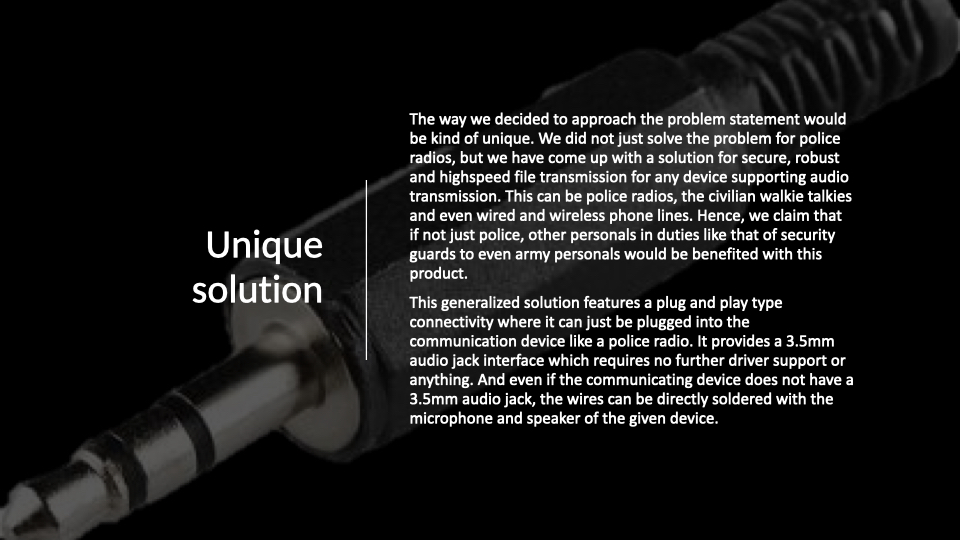
MediaRF transforms any audio communication channel (like a walkie-talkie or police radio) into a capable multimedia transmission system. The key insight is that multimedia data can be encoded into audio signals that are then transmitted over conventional radio systems and decoded at the receiving end. However, this seemingly simple idea requires solving several complex technical challenges related to bandwidth limitations, noise resilience, and security.
Technical Architecture:
1. File Compression Algorithms
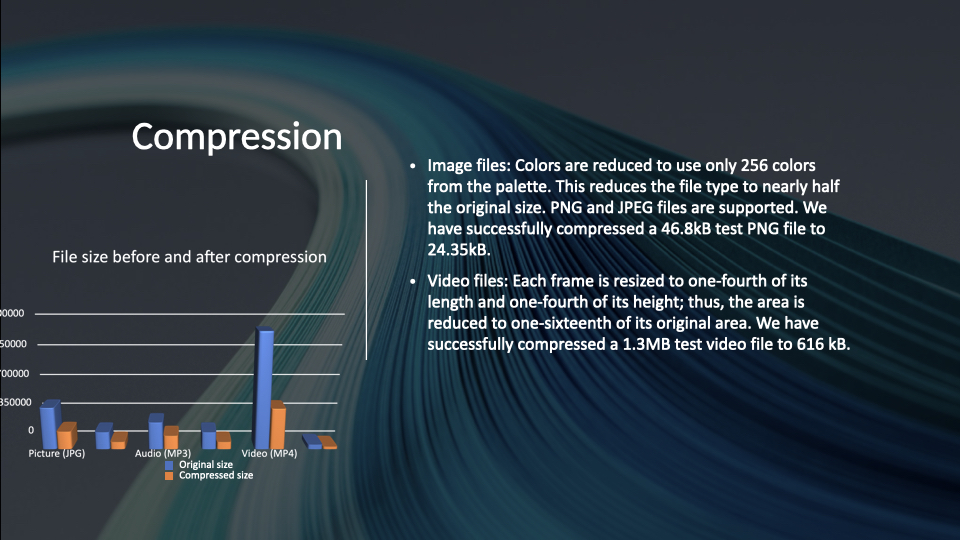
The first challenge in transmitting multimedia over audio channels is the severe bandwidth limitation. Police radios typically support audio in the 300-3000 Hz range, a fraction of what's needed for even modest image transmission. MediaRF addresses this through sophisticated compression:
- Adaptive Compression: The system automatically selects compression levels based on file type and urgency. Critical images might use lossless compression, while less critical files can be heavily compressed.
- Content-Aware Compression: For images, the system identifies and prioritizes important regions (like faces in suspect photos) ensuring these are transmitted with higher quality.
- Progressive Transmission: Large files are transmitted in layers, with low-resolution versions sent first to provide immediate context, followed by detail layers.
2. Cryptographic Security
Security is paramount for law enforcement communications. MediaRF implements military-grade encryption:
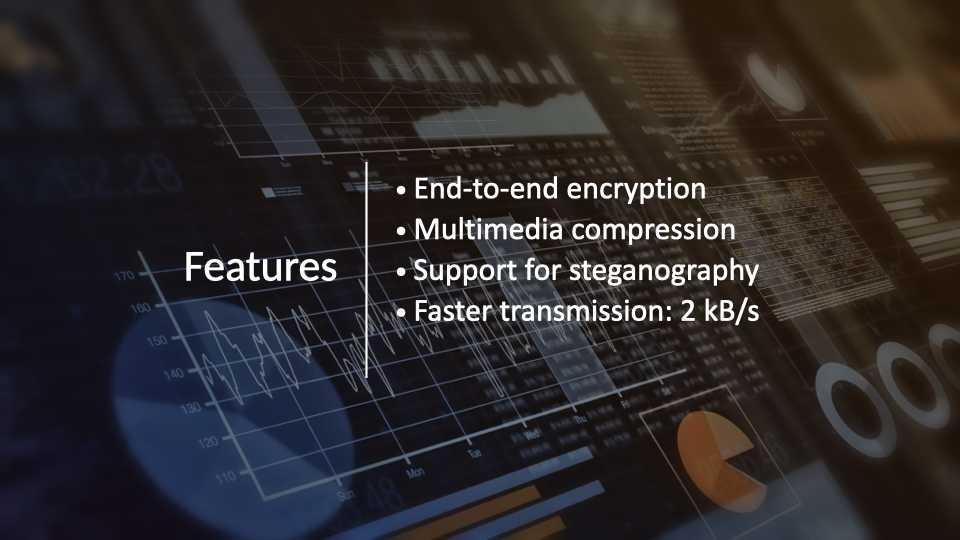
- End-to-End Encryption: All multimedia files are encrypted before transmission using AES-256 encryption. The encryption happens at the source device and decryption only at the intended recipient.
- Key Management: The system uses a secure key exchange protocol compatible with existing police radio encryption systems, ensuring seamless integration with current security infrastructure.
- Authentication: Digital signatures verify that transmissions come from legitimate sources, preventing spoofing attacks.
- Perfect Forward Secrecy: Each transmission uses unique session keys, so compromise of one message doesn't affect others.
3. Digital Modulation Techniques
The heart of MediaRF is its sophisticated modulation system that converts digital data into audio signals optimized for radio transmission. The system implements and intelligently selects between multiple modulation schemes:
Phase Shift Keying (PSK): PSK encodes data by varying the phase of the carrier signal. MediaRF implements several PSK variants:
- BPSK (Binary PSK) for maximum robustness in noisy conditions
- QPSK (Quadrature PSK) for balanced speed and reliability
- 8-PSK for higher data rates when channel quality permits
Frequency Shift Keying (FSK): FSK represents data by switching between different frequencies. MediaRF's FSK implementation:
- Uses carefully selected frequency pairs within the radio's passband
- Implements Gaussian FSK (GFSK) to reduce spectral spillover
- Adapts frequency separation based on channel noise levels
Quadrature Amplitude Modulation (QAM): QAM combines amplitude and phase modulation for maximum data throughput. MediaRF implements:
- 16-QAM and 64-QAM for high-speed transmission in good conditions
- Adaptive QAM that adjusts constellation size based on signal quality
- Sophisticated equalization to combat multipath interference
4. Adaptive Modulation Strategy
One of MediaRF's innovations is its intelligent, adaptive approach to modulation selection. The system continuously monitors channel quality using metrics like signal-to-noise ratio (SNR), bit error rate (BER), and multipath characteristics. Based on these measurements, it dynamically switches between modulation schemes:
- In poor conditions (low SNR, high interference), it uses robust BPSK or FSK
- In moderate conditions, it switches to QPSK or 16-QAM for better throughput
- In excellent conditions, it uses 64-QAM for maximum data rate
This adaptive approach ensures reliable transmission across varying conditions while maximizing data rates whenever possible.
Error Correction and Reliability:
Radio channels are notoriously unreliable, subject to fading, interference, and noise. MediaRF implements multiple layers of error correction:
- Forward Error Correction (FEC): Reed-Solomon and convolutional codes add redundancy that allows the receiver to correct errors without retransmission
- Interleaving: Data is shuffled before transmission so that burst errors (common in radio) are spread out and more easily corrected
- Automatic Repeat Request (ARQ): For critical data, the system requests retransmission of corrupted blocks
- Checksum Verification: Multiple checksums at different levels ensure data integrity
User Interface and Integration:
MediaRF was designed with the end user in mind—police officers who need a simple, reliable tool:
- Mobile Application: Intuitive smartphone app for selecting and sending files
- Automatic Configuration: System auto-detects connected radios and configures modulation parameters
- Real-time Feedback: Visual indicators show transmission progress and signal quality
- Offline Operation: Entire system works without internet or cellular connectivity
- Backward Compatibility: Doesn't interfere with normal voice communication
Performance Characteristics:
Through extensive testing, MediaRF demonstrated impressive performance:
- Successful transmission of photographs (640x480 resolution) in 15-30 seconds
- Short video clips transmitted at approximately 1 KB/second
- Robust operation even with SNR as low as 6 dB
- Less than 0.1% data corruption with error correction enabled
- Seamless integration with existing UHF/VHF police radio systems
Real-World Applications:
- Crime Scene Documentation: Officers can immediately share photographs of evidence with forensics teams
- Suspect Identification: Real-time sharing of suspect photos during manhunts
- Tactical Maps: Transmission of building layouts or tactical maps during operations
- Disaster Response: When cellular networks fail, emergency responders can still share critical visual information
- Border Security: Remote border patrol agents can send images to command centers
Smart India Hackathon Victory:
MediaRF's victory at the Smart India Hackathon 2022 was based on several factors:
- Innovation: Novel approach to multimedia transmission over voice channels
- Practical Impact: Addresses a real, urgent need in law enforcement
- Cost-Effectiveness: Works with existing infrastructure, no expensive hardware upgrades
- Security: Military-grade encryption suitable for sensitive operations
- Robustness: Reliable operation in challenging real-world conditions
- Implementation Quality: Working prototype demonstrated during the hackathon
Technical Challenges Overcome:
The development of MediaRF required solving several significant challenges:
- Achieving sufficient data rates within severe bandwidth constraints (3 kHz audio channels)
- Maintaining security without significantly reducing throughput
- Implementing adaptive modulation that responds quickly to changing conditions
- Creating error correction schemes that work well with the bursty errors typical of radio channels
- Ensuring the system doesn't interfere with emergency voice communications
Future Enhancements:
The MediaRF team continues to develop the system with planned enhancements including support for real-time video streaming (at reduced resolution), integration with body cameras, mesh networking capabilities for multi-hop transmission, AI-based image enhancement to improve quality of compressed images, and expanded support for different radio systems and frequencies.
Impact and Recognition:
Beyond winning the Smart India Hackathon, MediaRF has garnered interest from several state police departments and disaster management authorities. The project demonstrates how innovative engineering can extend the life and capabilities of existing infrastructure, providing advanced capabilities without the massive costs of complete system replacement. For rural and resource-constrained regions, this approach could be transformative, bringing modern communication capabilities to areas that might otherwise be left behind.